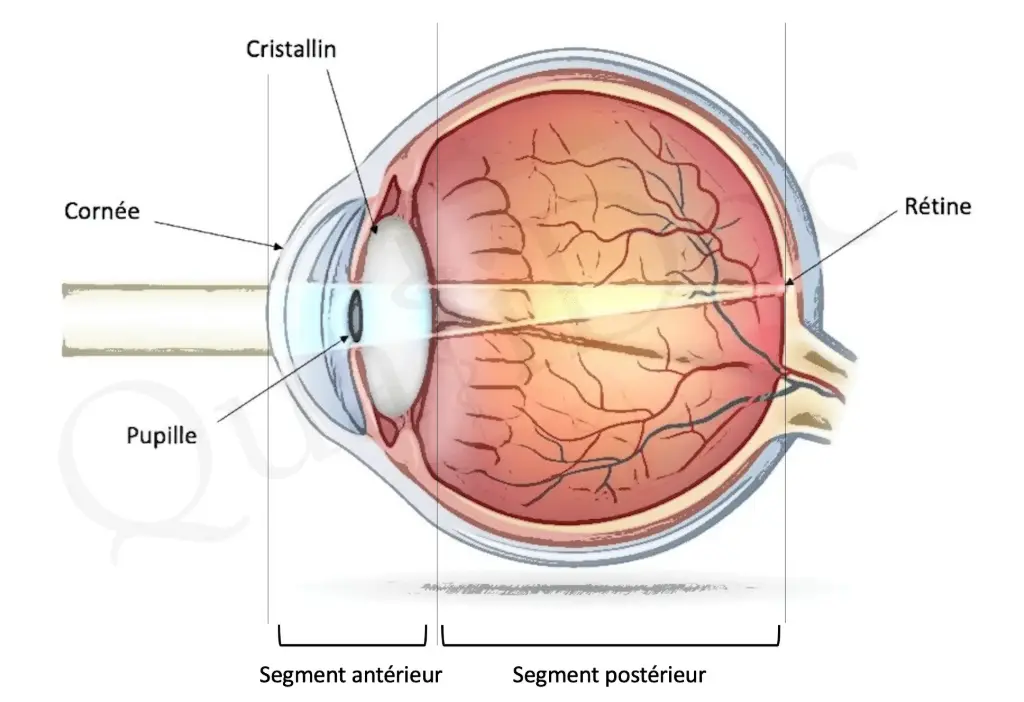
Anatomical reminder of the eye
The eye is a complex organ, made up of nerve cells, connective tissue, blood vessels, and nerve fibres, forming an optical system that refracts light reflected by objects. The cornea, aqueous humour, lens, and vitreous body schematically act as a converging lens to project the image onto the retina and send it to the brain via the optic nerve..

Normal vision
It's not just about having 12/10 vision in each eye to see well.
It is also necessary to have good binocular vision, a preserved visual field, good colour vision, good contrast sensitivity, good depth perception… here are the few essential functions that contribute to good eyesight.
Various pathologies can impair part or all of these faculties.
The pathologies

AMD - age-related macular degeneration
Age-related macular degeneration (AMD) is a retinal disease caused by a progressive degeneration of the macula, the central part of the retina, which most often appears from the age of 50, and more frequently from 65 years old, leading to a significant weakening of visual abilities, without completely destroying them. The precise causes of this disease are not known, and there is no cure. Existing treatments only allow for the slowing of its progression..
It is the most commonly encountered condition in low vision.

Diabetic retinopathy
Diabetic retinopathy is a retinal condition that occurs in the context of diabetes. The blood vessels that supply the retina are prone to being damaged; they may leak, dilate, or develop branches.
As it progresses, this disease can lead to blurred vision, blind spots, and floaters. Floaters are small spots that float in the field of vision..
If left untreated, diabetic retinopathy may lead to blindness. It is important for diabetic individuals to have regular eye examinations..

The glaucoma
Glaucoma is an eye disease related to the abnormal increase in intraocular pressure.
This abnormally high pressure gradually leads, most often without pain, to irreversible damage to the fibres of the optic nerve, and consequently to a decrease in vision..
Glaucoma can be a cause of blindness.

Retinitis pigmentosa
A degenerative process of the retina, leading to blindness in varying degrees of time. It is a hereditary, familial, chronic and progressive condition characterised by night blindness, abnormal pigmentation of the retina and a progressive decline in visual acuity (narrowing of the visual field